 Add to Chrome
 Add to Firefox
 Add to Edge
RoleCDE:Benchmarking and Mitigating Role-Alignment Trade-offs in Role-Playing Agents
Jun 01, 2026
Role-playing agents(RPAs) are widely used to steer large language models(LLMs) toward role-consistent behavior, yet existing benchmarks mainly evaluate surface-level fidelity and offer limited insight into decision making under role-alignment value conflicts. To address this gap, we introduce RoleCDE, the first benchmark designed to evaluate RPAs under structured conflicts between role-specific values and alignment-oriented constraints. RoleCDE formulates role-aware decision making as cognitive dilemma scenarios, jointly evaluating role-scenario grounding, value conflict resolution, and decision tendencies. The benchmark is constructed at scale, covering approximately 8k diverse role profiles and scenarios and nearly 24k dilemma instances across three difficulty levels and eight role categories. Evaluation of several mainstream LLMs reveals a "Role Value Decoupling" phenomenon, where agents systematically default to alignment-and morality-consistent decisions rather than role-specific values when the two conflict, even under explicit role conditioning. This behavior is largely invariant to dilemma difficulty but varies substantially across role categories. We further show that RoleCDE-based fine-tuning effectively mitigates this decoupling by improving value trade-off reasoning, while preserving general role-playing fidelity and general reasoning performance. Code is available at: https://github.com/rabbitrose/RoleCDE.

SkillGrad: Optimizing Agent Skills Like Gradient Descent
May 26, 2026Agent skills provide a lightweight way to adapt LLM agents to specialized domains by storing reusable procedural knowledge in structured files. However, whether downloaded from third parties or self-generated, these skills are often unreliable, incomplete, or outdated. Existing skill-evolution methods often address these deficiencies through heuristic reflections without an explicit optimization formulation. In this paper, we propose SkillGrad, a gradient-descent-inspired framework for optimizing agent skills. SkillGrad treats the skill package as a structured parameter to optimize in a gradient descent fashion: task executions provide trajectory-level loss evidence, automatic diagnoses then provide text-based gradients that indicate the correction directions. To stabilize optimization across iterations, a momentum agent accumulates recurring diagnostic patterns into a persistent memory overlay. Finally, an LLM-based patcher executes the parameter update by applying layer-aware edits to the skill package. Evaluated on SpreadsheetBench Verified and WikiTableQuestions, SkillGrad consistently outperforms training-based skill evolution baselines across two backbone LLMs, improving over the strongest training-based baseline by $6.7$ percentage points on average. Ablations further show that momentum and contrastive diagnosis both contribute to the final skill quality.
The Illusion of Reasoning: Exposing Evasive Data Contamination in LLMs via Zero-CoT Truncation
May 21, 2026Large language models (LLMs) have demonstrated impressive reasoning abilities across a wide range of tasks, but data contamination undermines the objective evaluation of these capabilities. This problem is further exacerbated by malicious model publishers who use evasive, or indirect, contamination strategies, such as paraphrasing benchmark data to evade existing detection methods and artificially boost leaderboard performance. Current approaches struggle to reliably detect such stealthy contamination. In this work, we uncover a critical phenomenon: a model's generated reasoning steps actively mask its underlying memorization. Inspired by this, we propose the Zero-CoT Probe (ZCP), a novel black-box detection method that deliberately truncates the entire Chain-of-Thought (CoT) process to expose latent shortcut mappings. To further isolate memorization from the model's intrinsic problem-solving capabilities, ZCP compares the model's zero-CoT performance on the original benchmark against an isomorphically perturbed reference dataset. Furthermore, we introduce Contamination Confidence, a metric that quantifies both the likelihood and severity of contamination, moving beyond simple binary classifications. Extensive experiments on both previously identified contaminated models and specially fine-tuned contaminated models demonstrate that ZCP robustly detects both direct and evasive data contamination. The code for ZCP is accessible at https://github.com/Yifan-Lan/zero-cot-probe.
PreFlect: From Retrospective to Prospective Reflection in Large Language Model Agents
Feb 06, 2026Advanced large language model agents typically adopt self-reflection for improving performance, where agents iteratively analyze past actions to correct errors. However, existing reflective approaches are inherently retrospective: agents act, observe failure, and only then attempt to recover. In this work, we introduce PreFlect, a prospective reflection mechanism that shifts the paradigm from post hoc correction to pre-execution foresight by criticizing and refining agent plans before execution. To support grounded prospective reflection, we distill planning errors from historical agent trajectories, capturing recurring success and failure patterns observed across past executions. Furthermore, we complement prospective reflection with a dynamic re-planning mechanism that provides execution-time plan update in case the original plan encounters unexpected deviation. Evaluations on different benchmarks demonstrate that PreFlect significantly improves overall agent utility on complex real-world tasks, outperforming strong reflection-based baselines and several more complex agent architectures. Code will be updated at https://github.com/wwwhy725/PreFlect.
AI Transparency Atlas: Framework, Scoring, and Real-Time Model Card Evaluation Pipeline
Dec 13, 2025AI model documentation is fragmented across platforms and inconsistent in structure, preventing policymakers, auditors, and users from reliably assessing safety claims, data provenance, and version-level changes. We analyzed documentation from five frontier models (Gemini 3, Grok 4.1, Llama 4, GPT-5, and Claude 4.5) and 100 Hugging Face model cards, identifying 947 unique section names with extreme naming variation. Usage information alone appeared under 97 distinct labels. Using the EU AI Act Annex IV and the Stanford Transparency Index as baselines, we developed a weighted transparency framework with 8 sections and 23 subsections that prioritizes safety-critical disclosures (Safety Evaluation: 25%, Critical Risk: 20%) over technical specifications. We implemented an automated multi-agent pipeline that extracts documentation from public sources and scores completeness through LLM-based consensus. Evaluating 50 models across vision, multimodal, open-source, and closed-source systems cost less than $3 in total and revealed systematic gaps. Frontier labs (xAI, Microsoft, Anthropic) achieve approximately 80% compliance, while most providers fall below 60%. Safety-critical categories show the largest deficits: deception behaviors, hallucinations, and child safety evaluations account for 148, 124, and 116 aggregate points lost, respectively, across all evaluated models.
MoM: Mixtures of Scenario-Aware Document Memories for Retrieval-Augmented Generation Systems
Oct 16, 2025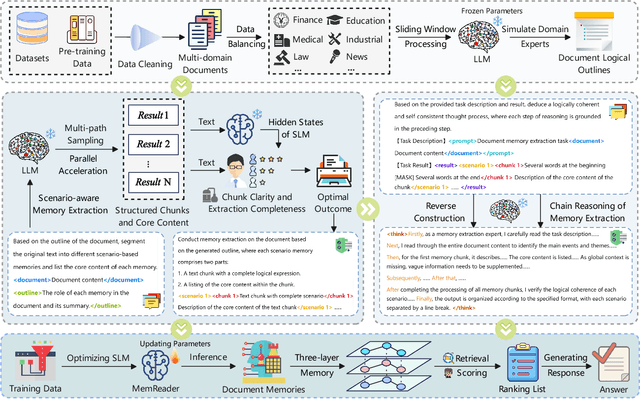
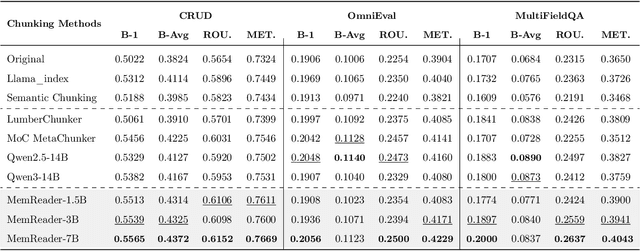
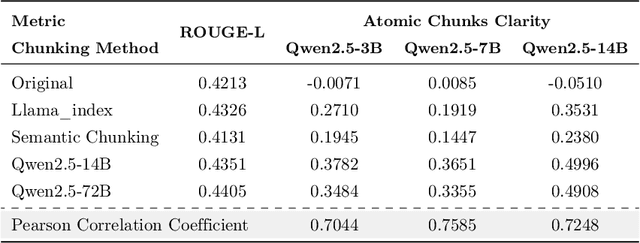
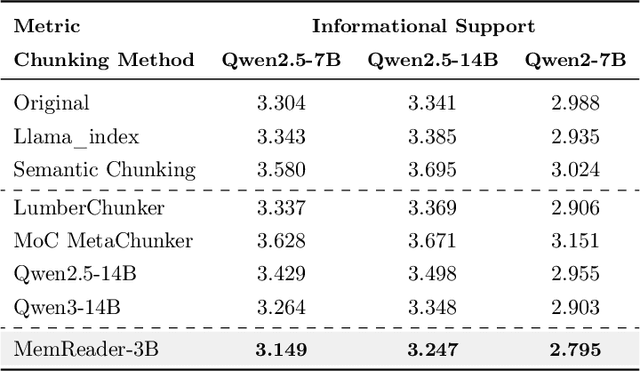
The traditional RAG paradigm, which typically engages in the comprehension of relevant text chunks in response to received queries, inherently restricts both the depth of knowledge internalization and reasoning capabilities. To address this limitation, our research transforms the text processing in RAG from passive chunking to proactive understanding, defining this process as document memory extraction with the objective of simulating human cognitive processes during reading. Building upon this, we propose the Mixtures of scenario-aware document Memories (MoM) framework, engineered to efficiently handle documents from multiple domains and train small language models (SLMs) to acquire the ability to proactively explore and construct document memories. The MoM initially instructs large language models (LLMs) to simulate domain experts in generating document logical outlines, thereby directing structured chunking and core content extraction. It employs a multi-path sampling and multi-perspective evaluation mechanism, specifically designing comprehensive metrics that represent chunk clarity and extraction completeness to select the optimal document memories. Additionally, to infuse deeper human-like reading abilities during the training of SLMs, we incorporate a reverse reasoning strategy, which deduces refined expert thinking paths from high-quality outcomes. Finally, leveraging diverse forms of content generated by MoM, we develop a three-layer document memory retrieval mechanism, which is grounded in our theoretical proof from the perspective of probabilistic modeling. Extensive experimental results across three distinct domains demonstrate that the MoM framework not only resolves text chunking challenges in existing RAG systems, providing LLMs with semantically complete document memories, but also paves the way for SLMs to achieve human-centric intelligent text processing.
Aria: An Agent For Retrieval and Iterative Auto-Formalization via Dependency Graph
Oct 06, 2025Accurate auto-formalization of theorem statements is essential for advancing automated discovery and verification of research-level mathematics, yet remains a major bottleneck for LLMs due to hallucinations, semantic mismatches, and their inability to synthesize new definitions. To tackle these issues, we present Aria (Agent for Retrieval and Iterative Autoformalization), a system for conjecture-level formalization in Lean that emulates human expert reasoning via a two-phase Graph-of-Thought process: recursively decomposing statements into a dependency graph and then constructing formalizations from grounded concepts. To ensure semantic correctness, we introduce AriaScorer, a checker that retrieves definitions from Mathlib for term-level grounding, enabling rigorous and reliable verification. We evaluate Aria on diverse benchmarks. On ProofNet, it achieves 91.6% compilation success rate and 68.5% final accuracy, surpassing previous methods. On FATE-X, a suite of challenging algebra problems from research literature, it outperforms the best baseline with 44.0% vs. 24.0% final accuracy. On a dataset of homological conjectures, Aria reaches 42.9% final accuracy while all other models score 0%.
Growing Visual Generative Capacity for Pre-Trained MLLMs
Oct 02, 2025Multimodal large language models (MLLMs) extend the success of language models to visual understanding, and recent efforts have sought to build unified MLLMs that support both understanding and generation. However, constructing such models remains challenging: hybrid approaches combine continuous embeddings with diffusion or flow-based objectives, producing high-quality images but breaking the autoregressive paradigm, while pure autoregressive approaches unify text and image prediction over discrete visual tokens but often face trade-offs between semantic alignment and pixel-level fidelity. In this work, we present Bridge, a pure autoregressive unified MLLM that augments pre-trained visual understanding models with generative ability through a Mixture-of-Transformers architecture, enabling both image understanding and generation within a single next-token prediction framework. To further improve visual generation fidelity, we propose a semantic-to-pixel discrete representation that integrates compact semantic tokens with fine-grained pixel tokens, achieving strong language alignment and precise description of visual details with only a 7.9% increase in sequence length. Extensive experiments across diverse multimodal benchmarks demonstrate that Bridge achieves competitive or superior results in both understanding and generation benchmarks, while requiring less training data and reduced training time compared to prior unified MLLMs.
RACap: Relation-Aware Prompting for Lightweight Retrieval-Augmented Image Captioning
Sep 19, 2025Recent retrieval-augmented image captioning methods incorporate external knowledge to compensate for the limitations in comprehending complex scenes. However, current approaches face challenges in relation modeling: (1) the representation of semantic prompts is too coarse-grained to capture fine-grained relationships; (2) these methods lack explicit modeling of image objects and their semantic relationships. To address these limitations, we propose RACap, a relation-aware retrieval-augmented model for image captioning, which not only mines structured relation semantics from retrieval captions, but also identifies heterogeneous objects from the image. RACap effectively retrieves structured relation features that contain heterogeneous visual information to enhance the semantic consistency and relational expressiveness. Experimental results show that RACap, with only 10.8M trainable parameters, achieves superior performance compared to previous lightweight captioning models.
Vision as a Dialect: Unifying Visual Understanding and Generation via Text-Aligned Representations
Jun 23, 2025
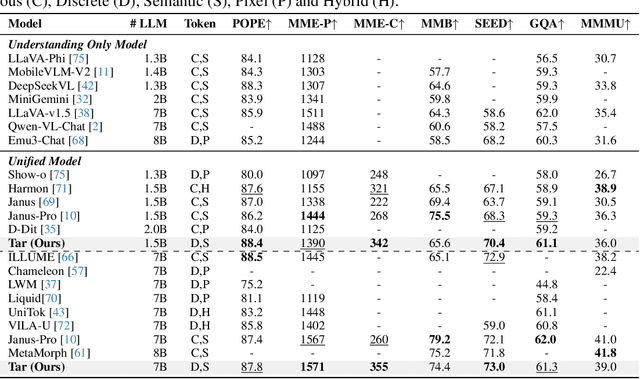
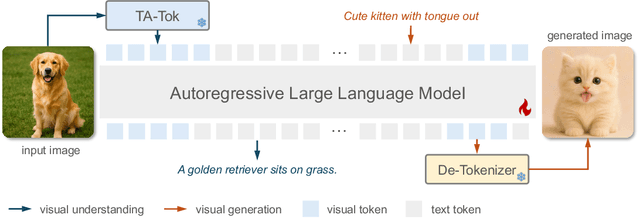
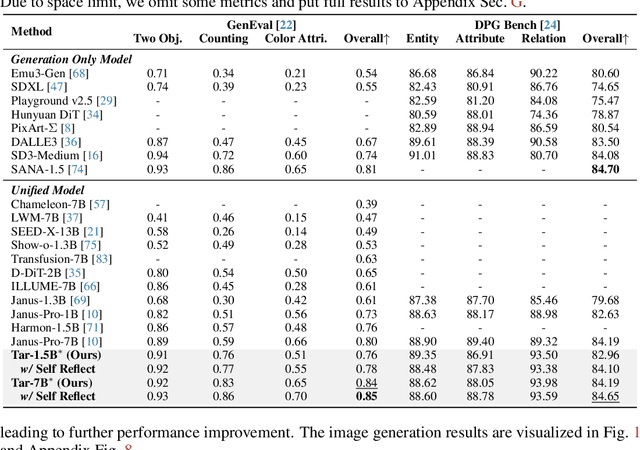
This paper presents a multimodal framework that attempts to unify visual understanding and generation within a shared discrete semantic representation. At its core is the Text-Aligned Tokenizer (TA-Tok), which converts images into discrete tokens using a text-aligned codebook projected from a large language model's (LLM) vocabulary. By integrating vision and text into a unified space with an expanded vocabulary, our multimodal LLM, Tar, enables cross-modal input and output through a shared interface, without the need for modality-specific designs. Additionally, we propose scale-adaptive encoding and decoding to balance efficiency and visual detail, along with a generative de-tokenizer to produce high-fidelity visual outputs. To address diverse decoding needs, we utilize two complementary de-tokenizers: a fast autoregressive model and a diffusion-based model. To enhance modality fusion, we investigate advanced pre-training tasks, demonstrating improvements in both visual understanding and generation. Experiments across benchmarks show that Tar matches or surpasses existing multimodal LLM methods, achieving faster convergence and greater training efficiency. Code, models, and data are available at https://tar.csuhan.com